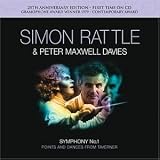
 Good to have these back. The recording of Maxwell Davies' 1st Symphony was made in August 1978 and came on Decca Head 21 (Decca Headlines was a valuable collection devoted to contemporary music, launched in the early 1970s. If my records are right, it did not go past Head 24/25, which had Birtwistle's Punch and Judy, reissued on CD first by Etcetera Birtwistle: Punch & Judy), then NMC (Birtwistle: Punch and Judy or Harrison Birtwistle: Punch and Judy). It was young (and not yet Sir) Simon Rattle's third outing on LP, I think, after a Rite of Spring made with a student orchestra and half an LP in which he accompanied Felicity Palmer in songs of Ravel. Not bad for starters. His appointment as Principal Conductor of the City of Birmingham Symphony Orchestra was still two years ahead. So in many ways this recording is, already, historical.
That said, Maxwell Davies's First Symphony is a tough nut to crack. It is long (almost 54 minutes), with a rather rambling slow movement lasting 18:30 and full of a pent-up menace that rarely fully erupts so that the movement never seems to really take flight. In lieu of Scherzo (2nd movement) there is another slow-movement-turning-into-a-fast-one, whose form is inspired by the 2nd movement of Sibelius' Fifth Symphony. The symphony's lyricism is austere and angular, it rises at times to great vehemence, its orchestration is refined and packed with events, sometimes even absolutely mesmerizing (such as in the eerie, flute-dominated passage at 2:57 in the finale) but they all seem somewhat arbitrary, as the symphony displays, I find, a rather elusive sense of direction and dramatic architecture. I can admire the details, I am never taken by the whole. Others may react differently of course.
I greatly prefer the "Points and Dances from Taverner", recorded in 1971 and originally released in 1973 on Argo ZRG712 which also had Fantasia 2 on Taverner's "In Nomine", with the New Philharmonia conducted by Charles Groves (hence the reference to that piece made by the composer in the liner notes reproduced from the original LP). I suppose that the word "point" is here taken in its meaning of "short musical phrase, especially one in contrapuntal music" (Merriam-Webster Dictionnary). The Points and Dances are excerpted from MD's opera Taverner, composed between 1962 and 1970 and premiered in 1972 at Covent Garden.
What I find fascinating is MD's brilliant transformation of Renaissance music into contemporary music. It's a tricky enterprise for a contemporary composer to use music from the past into music of the present: that kind of collage usually sounds awkward and artificial, ill-integrated. MD overcomes the difficulty brilliantly, by subjecting whiffs of themes with a Renaissance flavor to ear-catching timbral transformations and distortions. The harpsichord flourishes starting at 2:43 (track 5) sound like a Nancarrow etude played at double-speed (and a Nancarrow etude already sounds like a boogie-woogie played at double speed). The regal (a small, late-medieval portable organ) and positive organ in track 6 add their own eerie and nightmarish, bag-pipe-like sonorities in the keyboard points. It all sounds like fading images from a nightmare of a Renaissance scene, and makes one strongly regret that the complete opera isn't recorded.
Still, I'll keep this First Symphony for archival purposes (both on Rattle and on Maxwell Davies) more than sheer musical enjoyment.
Click Here to see more reviews about: Simon Rattle & Peter Maxwell Davies: Symphony No. 1; Points and Dances from Taverner (25th Anniversary Edition)
Buy cheap Simon Rattle & Peter Maxwell Davies: Symphony No. 1; Points and Dances from Taverner (25th Anniversary Edition) now

0 comments:
Post a Comment